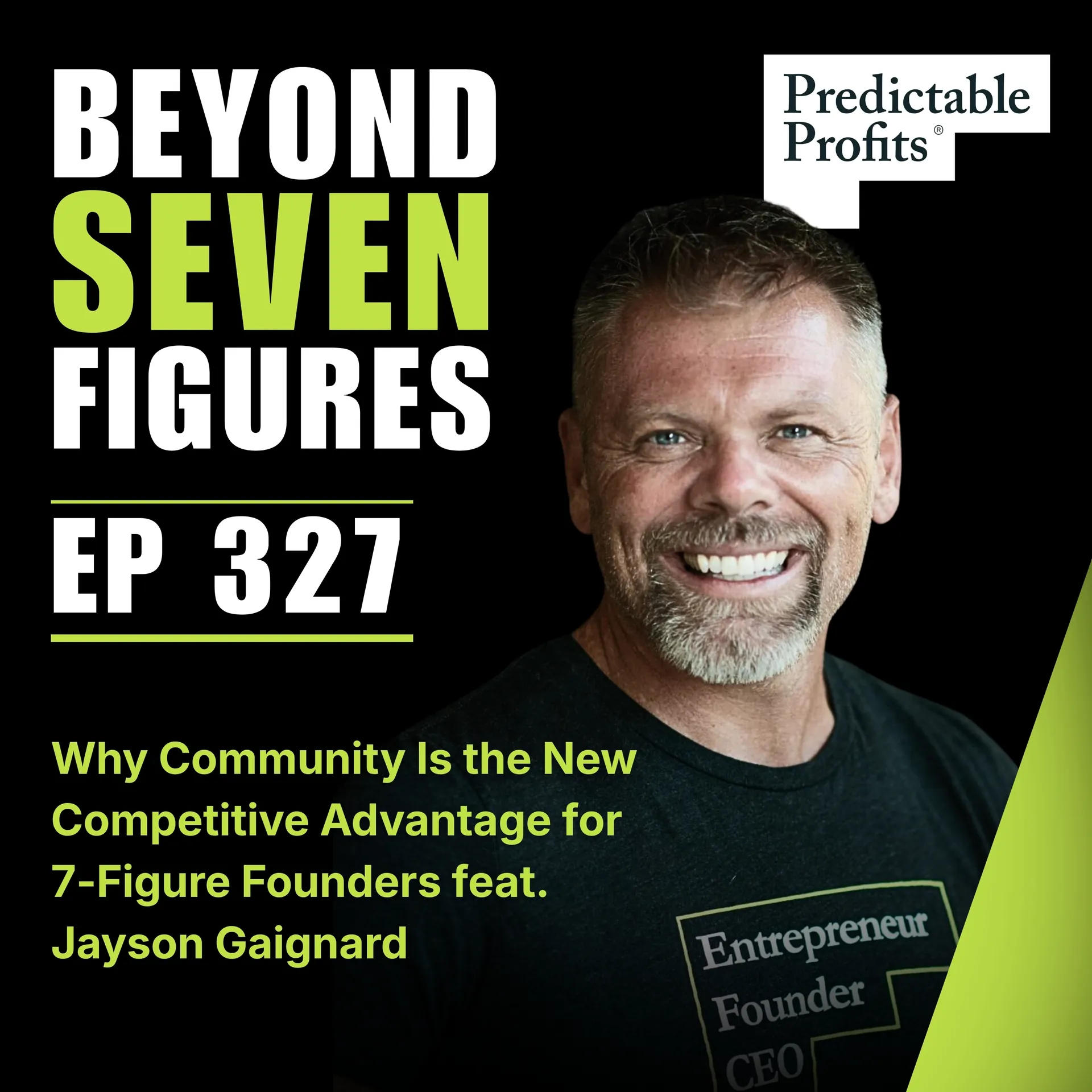
Episode 327: Why Community Is the New Competitive Advantage for 7-Figure Founders feat. Jayson Gaignard
Information is getting cheaper by the day. The right peer group is not. Jayson Gaignard and I talk about why a curated community, not a bigger network, is becoming a competitive advantage for 7-figure founders. If growth still runs through you, start with unpredictable revenue.
Jayson is the founder of MMT and the author of Community Made. He is a longtime friend, and this is a different conversation from our 2022 episode. That one is still up if you want it. This one is about why curation beats scale, and why “How can I help you?” is often the wrong opening question.
When we first met, I was surprised by the wait list to get into MMT. On this episode I said it was a six-year wait list. He still uses one. The point is not the length of the line. The point is that he built the room by deciding who does not belong in it.
He contrasted MMT with groups designed for scale. He named EO and YPO, and said organizations like those can run 20,000 or 30,000 plus members as long as someone meets a revenue target and a role title. His own filter started simpler, and it made him the bottleneck. He later turned that instinct into a process so the standard was not trapped in his head. Who you keep out protects the culture of the room. I closed the episode the same way: it is not just about who you let in. It is even more important who you don’t let in.
That is also how I think about our own founder community. It is not MMT, and it is not a bigger list. It is a room with a door. For a broader look at competitive advantage in a service business, start there after you listen.
Jayson draws a hard line between networking and community. Networking, in his words, is often performance. Community is the room you want to come back to. The shift is from “I can’t wait to meet this person” to “I can’t wait to see this person again.” He said the relationships that matter are the ones that stay in your life long enough to compound, especially when people can take the mask off. He also shared a personal family health moment, which I will not expand here, as an example of what becomes possible when someone is honest in a room like that. A person in that room made an introduction that mattered. He said a performance-based community would not have produced the same result.
If you want a concrete move from this conversation, stop opening with “How can I help you?” Jayson says that question hands the work back to the other person. Listen for what they are actually struggling with, then offer something specific. I closed the episode the same way. That question often confesses that you have not taken the time to understand them yet.
Jayson walked through ways he invests in a relationship so the other person feels seen: resources, gratitude (especially when you say it in public), a timely check-in, investing in someone’s inner circle, and a thoughtful gift. The test is simple: did the other person feel seen, or did you just try to be useful in the abstract?
His closing advice was about peer proximity. If you want to build an eight-figure company, he said, you will need eight-figure teams, eight-figure systems, and eight-figure relationships. Look at who is one or two steps ahead of the problem you are actually trying to solve, and spend more time in that room. That is a different job from scaling a service business without burning out by adding more volume.
KEY TAKEAWAYS:
- As AI makes information cheaper, a peer group with different experience becomes harder to replace.
- A wait list is not the asset. The filter that created it is.
- It is not just about who you let in. It is even more important who you don’t let in.
- Groups built for scale optimize for a revenue number and a title. A curated community optimizes for whether you would want that person in the room.
- Who you keep out protects the culture of the people you keep in.
- Networking is often a performance. Community is the room you want to return to, because the relationships compound.
- Honesty in the room creates introductions and bonds that a performance-based network usually will not.
- “How can I help you?” puts the work on the other person. Listen first, then offer something specific.
- Jayson invests in relationships with resources, gratitude, check-ins, someone’s inner circle, and thoughtful gifts.
- Making someone feel seen is rarer than most founders think, and it is the test of whether the investment landed.
- Companies can build this around their customers, not only around a founder peer group.
- Jayson’s beyond-seven-figures tip: be deliberate about peer proximity, including the relationships around the next stage of the company.
Connect with Jayson Gaignard:
- MMT: MastermindTalks
- Book: Community Made. On the episode, Jayson said to look it up on Amazon.
- A different conversation from our 2022 episode with Jayson.
Learn more about Predictable Profits and the Predictable Profits Community.
Growing a business is hard, but it doesn’t have to be. In this podcast, we discuss strategies for growing and expanding a business beyond seven figures.
The show mixes practical teaching with expert interviews so you can take ideas back to your company and use them. Enjoy the show.
Please rate, review, and subscribe so you don’t miss future episodes. Your reviews help us improve the show.
Follow Charles Gaudet and Predictable Profits on social media: Facebook: facebook.com/PredictableProfits Instagram: instagram.com/predictableprofits Twitter: twitter.com/charlesgaudet LinkedIn: linkedin.com/in/charlesgaudet Visit: Predictable Profits Predictable Profits Community
FAQ
Why is community becoming a competitive advantage for 7-figure founders?
In this conversation, Charles and Jayson argue that AI is making information abundant, while a peer group with different experience gets harder to replace. Jayson also said that as more work goes virtual, founders will need rooms where people can be honest and relationships can compound.
How is a community different from networking?
Jayson contrasts performance-based networking, where you show up to impress people, with a curated space where people can be honest. In his framing, community is the room you want to return to, because the relationships compound year after year.
Why does Jayson say “How can I help you?” may be the wrong question?
Because it puts the work on the other person. Jayson says you should listen for what they are actually struggling with, then offer something useful. Charles closed the episode the same way: that question often signals you have not taken the time to understand them yet.
Did you catch our last episode?
So don’t forget to subscribe to the show to get that episode as soon as it is released. Until then, be profitable.

The Predictable Profits Newsletter
Build a More Predictable Pipeline. Close More of the Right Deals.
Get practical lessons each week to help you generate more qualified leads, improve sales conversion, and create consistent growth without relying on heroics or luck.