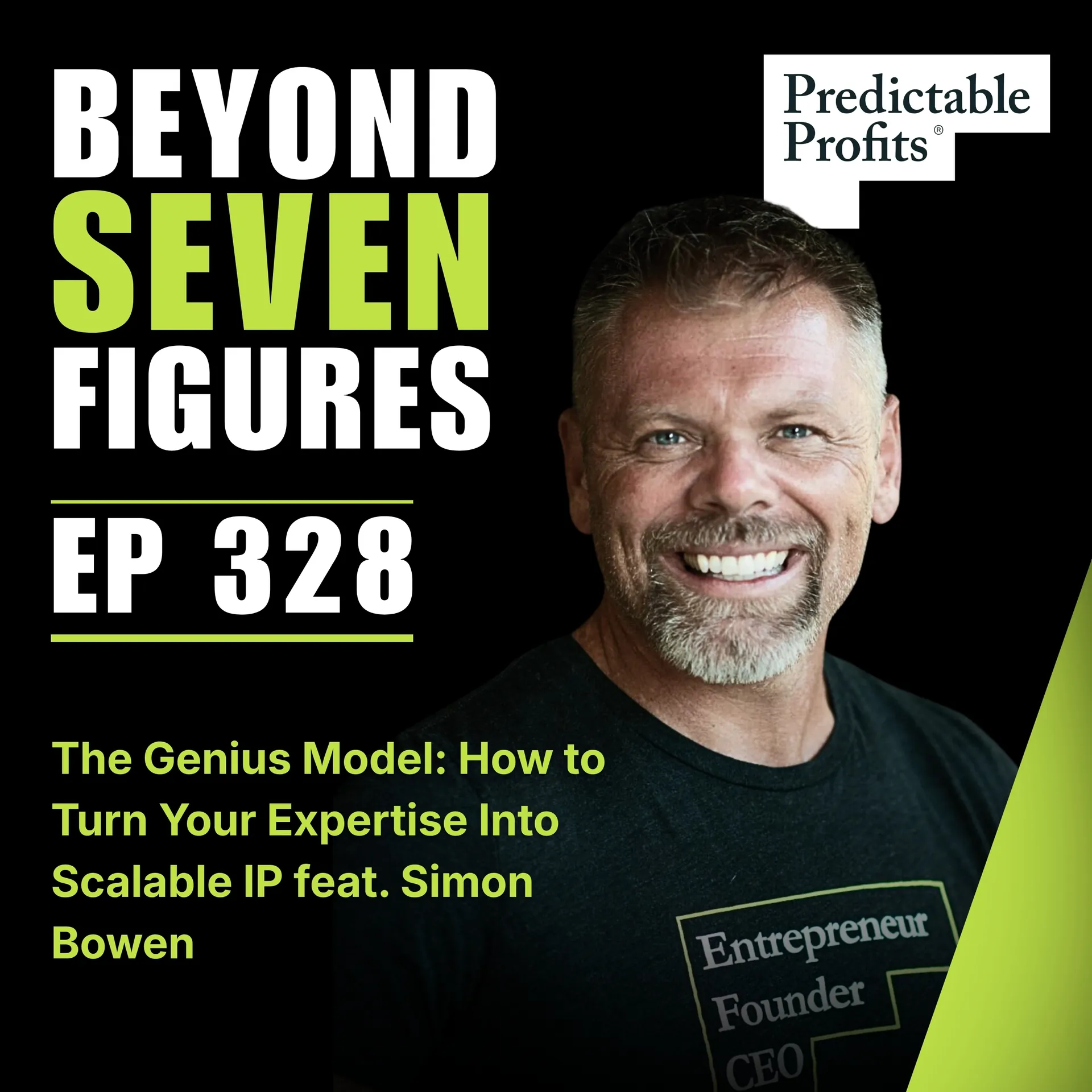
Episode 328: The Genius Model: How to Turn Your Expertise Into Scalable IP feat. Simon Bowen
Your expertise is hard to sell, scale, or transfer if it only lives in your head. Simon Bowen and I talk about how visual models turn that thinking into intellectual property other people can see and use. If the company still depends on you, start with how to leave the Founder’s Trap.
Simon joined us from Perth. He is the person behind the Genius Model, and I have worked with him on how we communicate the thinking inside Predictable Profits. His starting point on the episode was simple. A physical product is easier to explain because the buyer can hold it. A service business is selling thinking, and thinking is easy to hide.
He put it this way: what a customer cannot touch, they cannot put a price on. Money is tangible. A complex service is not. The two systems he cares about are the system for thinking and the system for influence. Visual models, in his method, do both. The brain works in images, not paragraphs, so a drawing can carry a point that a verbal explanation drops.
Simon said he spent 25 years in corporate consulting using visual models as his main tool. He mentioned work with firms including McKinsey and Pricewaterhouse, and a reputation in Australia for getting groups that disagreed into agreement. He would listen, then go to the whiteboard and say, “I think I can draw this for you.” The drawing pulled people in. They started building the model with him instead of sitting through a speech.
That is also why a verbal explanation often fails. If you only talk, you skip steps you take for granted, and the other person gets lost. Walking through a model forces you to show the pieces you would otherwise assume they already know. Simon’s line on this is one I want you to keep: the market cannot buy your intuition. It has to buy organized genius. A prospect needs to try the model on and sit inside your thinking with you.
I learned that the hard way in my own work with him. Before we started, my models were more like artwork. I was making them too complex, and the point got harder to see. His models break down into simple shapes, a square, a triangle, or a circle, and a storyline. The craft is not the drawing. The craft is the choreography: what point you are making, and in what order.
If you want a concrete move from this episode, find what Simon calls the ache. He uses an iceberg. The known problem is the one the customer will say out loud, like “help me with sales.” Just below the surface is a hidden problem they already know, and they know you know, but they do not lead with it. At the bottom is the unknown problem, the ache they cannot name or point to. In his example, the sales complaint was not only a skill issue. It was that the founder might not believe the business is built to matter, which is a design problem, not a pitch problem. You get there in the customer’s language, not yours.
That is how this ties to the Founder’s Trap. When the thinking lives only in your head, the company cannot stop being the bottleneck. Simon’s point at the end of the conversation was that the founder’s thinking can live inside the model. When the founder steps back, the thinking is still there. The job is to get the thinking out of your head and onto a page other people can use.
KEY TAKEAWAYS:
- In a service business, the asset is often the thinking behind the work, not the deliverable itself.
- What a customer cannot touch, they cannot put a price on. That is why hidden expertise is hard to sell.
- Simon treats visual models as a system for thinking and a system for influence.
- He spent 25 years using this as his go-to tool in corporate consulting.
- “I think I can draw this for you” changes the conversation. People start building the model with you.
- The market cannot buy intuition. It has to buy organized genius, meaning thinking a prospect can try on.
- Keep the model simple. The hard part is the story and the sequence, not the shapes.
- Find the ache under the problem the customer will articulate, and use their language.
- A “we need help with sales” request may be sitting on top of a design problem, not just a skill problem.
- If the founder’s thinking lives in the model, the business is less stuck when the founder steps back.
Connect with Simon Bowen:
- Models Method, named on the episode as the place to learn more about his work.
Learn more about Predictable Profits and the Predictable Profits Community.
Growing a business is hard, but it doesn’t have to be. In this podcast, we discuss strategies for growing and expanding a business beyond seven figures.
The show mixes practical teaching with expert interviews so you can take ideas back to your company and use them. Enjoy the show.
Please rate, review, and subscribe so you don’t miss future episodes. Your reviews help us improve the show.
Follow Charles Gaudet and Predictable Profits on social media: Facebook: facebook.com/PredictableProfits Instagram: instagram.com/predictableprofits Twitter: twitter.com/charlesgaudet LinkedIn: linkedin.com/in/charlesgaudet Visit: Predictable Profits Predictable Profits Community
FAQ
What is the Genius Model, as used in this episode?
Simon Bowen uses that name for his method of turning complex thinking into visual models other people can see, try on, and act on. He says the market cannot buy a founder’s intuition until that thinking is organized so a prospect or team can sit inside it with you.
How does turning expertise into IP help a founder escape the Founder’s Trap?
In this conversation, the business stays dependent when the thinking lives only in the founder’s head. Simon’s point is that once the thinking lives in a model, the founder can step back and the thinking is still there. That makes the work easier to sell, transfer, and scale. See also what the Founder’s Trap is.
What is the “ache” Simon wants you to find?
Simon uses an iceberg: the problem the customer will say out loud sits on top, a hidden problem sits just below the surface, and the ache is at the bottom. It is the deeper problem they cannot name or point to, but still need solved. He says you have to use their language, not yours, to get there.
Did you catch our last episode?
So don’t forget to subscribe to the show to get that episode as soon as it is released. Until then, be profitable.

The Predictable Profits Newsletter
Build a More Predictable Pipeline. Close More of the Right Deals.
Get practical lessons each week to help you generate more qualified leads, improve sales conversion, and create consistent growth without relying on heroics or luck.