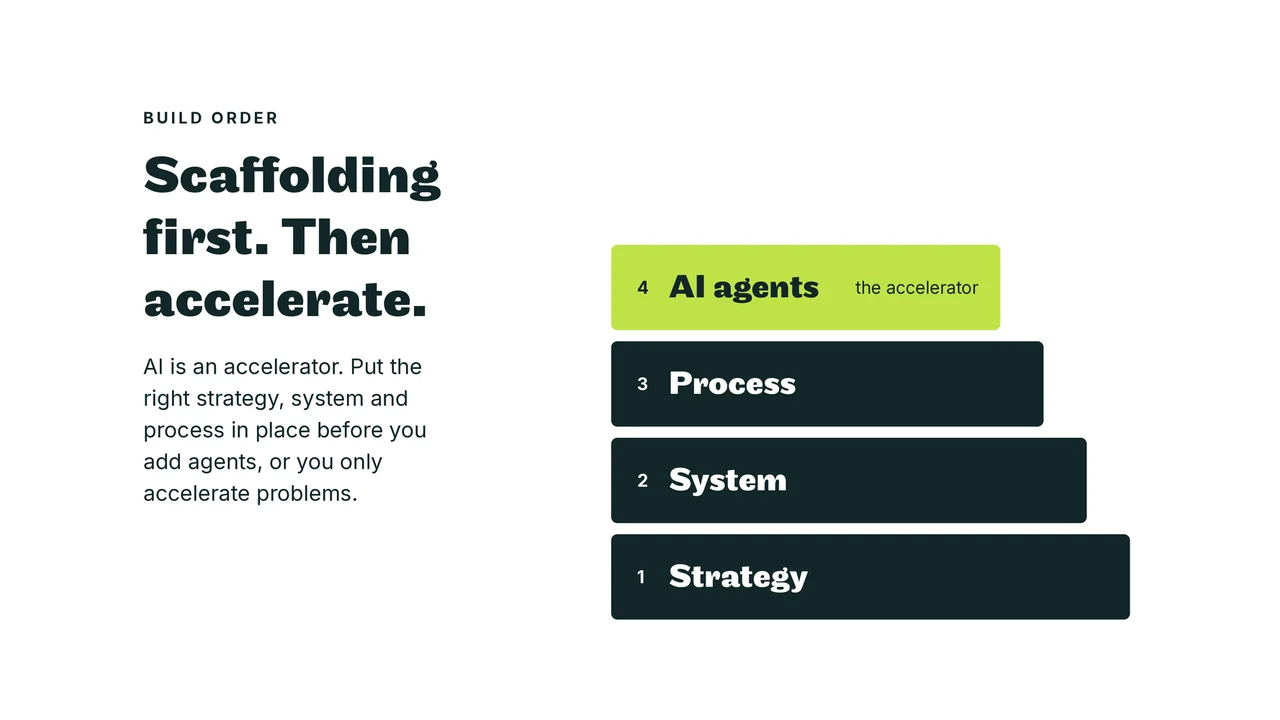
Start slow. A small business needs one AI agent to begin, with one nurture job and one person on your team who leads the work. For a service firm with unpredictable revenue, a good first job is nurturing demand. That means following up with leads who already know you so more of them become sales calls. Add the next agent when the first earns your trust and someone has time to lead each agent like an employee.
My over-70-agents mistake, and how I run agents now
I’ve been using AI agents since February 2026. My biggest mistake was following all the advice I got online.
People were bragging about having all these bots. One guy said he had 140 bots. So at one point, I had over 70.
It was the best and worst thing to happen to me. For starters, I learned the wrong way to do it. I had organized chaos and a bunch of half-baked slop. It was causing me more frustration and overwhelm than before I had the agents.
I brought in way too many bots, way too fast. I didn’t properly onboard them, and I didn’t manage them. Instead, I expected them to know what I wanted without being told. At best, all they did was average output.
What I do now: lead each agent like a remote employee
So I connected with one of the smartest people I know in AI, who worked with Fortune 500 companies to set them up. I learned that the right way was the opposite of what the online crowd was talking about.
AI agents aren’t a technology. They are an alternative life form, and they must be treated like that. Like a remote employee.
So, like a team member, each agent I bring on has a job description and KPIs. I onboard each one the way I’d onboard a human, with training, materials, systems and skills. Then I give the agent some test projects and I give feedback.
You don’t download a template from a marketplace and let it go hog wild.
I hold one-on-ones with my agents at least once a week. We review the data and the output. Then I refine the skills, the context and the workflows as needed. Gallup’s research on human teams finds that 80% of employees who got meaningful feedback from their manager in the past week are fully engaged, and that 15 to 30 minutes is enough if the conversations happen often. I apply the same habit to my agents.
Put your first agent to work on nurturing demand
The Predictable Profits Operating System is how we help service founders fill the sales pipeline. The work runs in four stages: create demand, capture demand, nurture demand and sell. Agents are one tool that runs inside that system. People lead them, and the system tells them where to work.
A good place for a first agent is nurturing demand. These are the leads and prospects who already know you. They took a first call or asked a question, and then they went quiet. Speed matters here. A 2011 Harvard Business Review study of online sales leads found that most companies were not responding to new inquiries nearly fast enough. Following up with each one by hand takes time, and on a busy week some of them never hear from you again.
That’s a good job for an agent. Your agent drafts the follow-up email. A person on your team reviews the draft, fixes the tone and sends the email. The agent handles the repeat work, and the person keeps the relationship and books the sales call.
Why bot count is the wrong number to chase
A bot count measures how many agents someone switched on. The better test is whether those agents do good work and help fill the pipeline.
Every agent you add is a seat on your team. Somebody has to write its job description, review its output and give feedback every week. When nobody does that, the agent drifts toward average work, which is what I got with 70.
AI will make average work less expensive. Leadership is what makes work exceptional. So the limit on how many agents you can run well comes from leadership time. The tools will let you spin up as many as you want.
Do the math on your own calendar. Each agent needs a weekly one-on-one where a person reviews its data and output and refines its instructions. Multiply that by the number of agents you want and you get the hours your team has to find every week. If those hours aren’t there, the extra agents produce slop.
What your first AI agent needs before it goes live
Keep the first one simple. Your first agent needs five things.
- One job that repeats. Pick nurture work your team does every week in roughly the same way, such as drafting follow-up emails to leads who went quiet after a first conversation. A person on your team reviews each draft and sends the email.
- A number the agent answers for. If you can’t name the number, you have no way to tell whether the agent is doing the job.
- A named leader. This is a person on your team who owns the result. The agent makes that person better at their work, and that person stays accountable.
- A job description you can write. If you can’t put on one page what good output looks like, the agent won’t figure that out either.
- Test projects before real work. Give the agent a few jobs where mistakes cost nothing, review them with its leader, and give feedback before any draft reaches a lead.
The full setup for leading an agent after launch is in Should You Manage AI Agents Like Employees?.
When to add the next AI agent
Before you add another agent, answer three questions with a yes or a no.
- Does the first agent do its job consistently, and do you trust its output without rechecking every line?
- Does the person who would lead the next agent have time on their calendar for a weekly one-on-one?
- Can you write the next agent’s job description, and the number it answers for, before you build it?
If any answer is no, wait. Fix that gap first.
As the agents perform more consistently, you build trust with them. That trust opens up your time to start building out other agents and other projects. The next agent doesn’t have to report to you. Often the better move is to hand the new one to someone else on your team who is ready to lead one. That’s how agents end up making good employees better. My team has already made a dramatic impact in their day-to-day activities. They used to spend 80% of the time doing tasks and 20% on strategy. Now it’s reversed. They’re only spending 20% of the time doing and 80% strategizing, reviewing agent output, and managing.
The drawback of going slow
Going slow feels like falling behind. Your feed is full of people posting their bot counts, and you’ll be running one agent.
Leading agents also takes real time every week. You’ll sit in one-on-ones with your agents, read their output and rewrite their instructions. Some weeks that feels like a chore. And going slow might not be the sexy thing that drives a bunch of clicks.
Slow is still the better bet. I tried the fast way first and got average output and more overwhelm than I had before. If you’re going to build a team of AI agents, you’re better off going slow, being methodical, and getting the work done well.
Where to start this week
- Pick one repeating nurture job, such as follow-up emails to leads who went quiet. Write a one-page job description for the agent, including the one number the agent answers for.
- Name the person on your team who will lead it, and put a weekly one-on-one with the agent on their calendar, even a short one.
- Build the agent and run it through test projects first. Have its leader review the output and refine the skills, context and workflows before it does real work.
If you want a second set of eyes on where your growth stalls, book a Business Growth Stack Session. In 60 minutes, a senior business coach maps your pipeline on your real numbers and shows you what to fix first. No fee.
FAQ
How many AI agents should a small business start with?
One. Pick one agent that owns one repeating job and one number, with one person on your team who leads it. A nurture job is a good place to start, like drafting follow-ups to quiet leads for a person to review and send. Onboard the agent like a new hire, give it test projects, and review its output every week. Add more only after that first agent does its job well.
When should I add a second AI agent?
Add one when your first agent does its job well and you trust its output. Someone on your team also needs time for a weekly one-on-one with the new one. You should also be able to write its job description and number first. If not, wait.
Can AI agents replace my team?
No, and we don’t use them that way. Agents make good people better. I hold one-on-ones with my agents at least once a week, and we review the data and the output. Each agent helps a person on your team do more of their best work, and that person stays responsible for the result.
Related: Setup → Sales → Scale
- Setup: What should I do first if revenue is unpredictable and I’m still closing every deal?
- Setup: What Changes in the First 90 Days With a Business Coach
- Sales: How to Delegate Sales When You Close Every Deal
- Scale: Should You Manage AI Agents Like Employees?
- Scale: What Data Should a $1M to $10M Founder Watch Each Week?
- Scale: How to Use AI to Scale a Service Business
The Predictable Profits Newsletter
Build a More Predictable Pipeline. Close More of the Right Deals.
Get practical lessons each week to help you generate more qualified leads, improve sales conversion, and create consistent growth without relying on heroics or luck.