Yes, you should manage AI agents like employees, but a person always owns the result. At Predictable Profits, we lead our agents the way we’d lead a remote hire: a seat on the org chart, one KPI, a written job description, onboarding in our mission, vision and values, and a manager who reviews the work. Agents fix nothing on their own. If your firm runs on unpredictable revenue, build the system before you add AI.
What a barber shop taught me about briefing AI agents
I had my AI agent call my barber shop to book a haircut. The shop booked me for 9 a.m. Then they hung up before the agent could say I wanted Bart. Bart is my barber.
The agent called back on its own, fixed the booking and reported back to me. The brief is the reason it did that. I hadn’t said “get me a haircut.” I had been really clear about what a successful outcome looked like: an appointment with Bart. A 9 a.m. slot with whoever was open didn’t meet that bar, so the job wasn’t done yet.
Whether you hand work to a person or an agent, be really clear about what good looks like. If you don’t tell it what good is, it will default to the AVERAGE. AI knows everything about business and nothing about yours. Closing that gap is the leader’s job.
Why “buy the tool” gets you a faster version of average
My social media feed is filled with it, and it’s driving me bananas. People claim to be replacing their employees with AI, firing their agencies, posting about how they’re building a one-person company. Sure, it sounds sexy. Less overhead and less frustration.
I think we’re setting our sights too low. If the best we see in AI is doing the same work with fewer people, we’ll end up building a faster version of the AVERAGE.
The other camp says agents are software. Keep them off the org chart, treat them like any other tool and move on. That road ends in the same place, because nobody is leading the work.
The better opportunity is good people working with a well-led team of agents. The best performing companies treat an AI agent with the same regard as a remote employee. They feed it their mission, vision and values. They put it on an org chart, give it a KPI and manage it.
You wouldn’t hire a remote employee, give them two sentences about the business, then disappear and expect wildly successful, above average work, right? Yet that’s what people are doing with AI, and they’re surprised by subpar results. Agents, like employees, need to be onboarded, coached, and given direction, goals and feedback. That takes good old fashioned leadership. Tools cannot replace leadership.
And the stakes are bigger than most people think.
Why I believe this is the biggest point
An A-player in 2025 performs at one level. I believe that by the end of 2026, an A-player has the tools and the technology to be able to produce at 100x what an A-player did in 2025. And then in 2027 that could be as high as 1,000x. That’s what I believe, not a measured number.
So running a business and not giving your team this type of technology and agentic AI puts you at a significant disadvantage against others in your industry.
That kind of output only shows up when the agents are led well. The rest of this article is how we lead ours.
What every agent gets on our team
This is how we run our own company on people plus AI agents. Each agent gets what a remote hire would get.
A seat on the org chart
We keep one org chart for the whole company, people and agents together. Every card shows four things: manager, KPI, title and a job description. A card missing any of the four is not done.
Every agent has exactly one owner. As CEO, I manage a few leads, not every agent. As your team grows, move agents under the team member they serve.
One KPI with a source
Each agent gets one KPI, tied to a company goal, with a named live data source such as your CRM. No source, no KPI. Don’t invent a vanity metric to fill the box.
Giving an agent three KPIs is a common mistake. When the numbers pull in different directions, the agent has no way to know which one matters, and neither does the person reviewing it.
A real job description
Write the job description before the agent does any work. Give it as much detail as the job needs. Some jobs need a lot more than a sentence. If you can’t write it clearly, the job isn’t clear enough to hand off or to review. Then add what good looks like, the same way I wrote “an appointment with Bart.”
Onboarding
You onboard an agent just like you would onboard a human, with training and materials and skills. The materials include our mission, vision, values and the company’s North Star, the one goal everything else points at. Then you give it some test projects. Then you provide it with feedback. You don’t just download a template from a marketplace and have it go hog wild.
Skip this step and you get an agent that knows business in general and nothing about your firm.
A manager
I have bot managers. I still have to manage them. I weigh their work against what good looks like and ask whether it could be better. As soon as you stop managing, your performance goes down.
We route feedback to the right level:
- Tell the agent when it could fix the issue on its next piece of work. Tone, length or a mistake.
- Go to its manager when the feedback changes the plan. Priorities, or weak results overall.
- Take it to whoever runs the whole system when it changes the system. A rule, an owner, or feedback you gave before that changed nothing.
”But HBR says don’t treat agents like employees”
A May 2026 Harvard Business Review article by researchers at BCG reported an experiment with more than 1,200 managers. When AI was framed as an employee, managers caught fewer errors and put more of the blame on the AI. I understand the concern, and part of it is right.
If you call an agent an employee, people can stop owning the result and start blaming the agent. That’s blurred accountability, and it’s a real failure mode.
My answer is that this risk shows up when the leader stops leading. The problem is missing accountability, and you fix it with structure. So we lead agents like employees and hold people accountable like a manager would:
- One owner per agent. A named person answers for everything that agent produces.
- Approval tiers based on what happens if it’s wrong. Low tier is reversible and internal, so the agent does it and logs it. Medium is reversible but visible to a person or a shared tool, so the agent does it and tells the owner. High is anything irreversible, external, public or that costs money, so the agent stops and asks. When in doubt, use the higher tier.
- Verified status. Before an agent relays a status or a number, it checks the live source and says what it checked and when. If it can’t check, it says unverified.
- A named person who can stop it. Every agent has one.
The agent is never the scapegoat, and it’s never the hero either. The person at the top of that line answers for the result, the same way a manager answers for their team.
What it changes for your people
This is my own estimate about my own team, not a measured study. They used to spend 80% of their time doing tasks and 20% on strategy. Now it’s reversed. They spend 20% of the time doing and 80% strategizing, reviewing agent output and managing.
The goal is making good people better, not replacing them.
That shift changes the job itself. Everybody’s going to be a director-level person, because they’re going to be managing a team of agents. Your employees will spend their days reviewing and offering feedback, the way I do now. Everyone’s going to need to be an intrapreneur, someone who runs their piece of the business like an owner would.
The time adds up fast. As a business owner, saving 10 minutes here and there is a big deal. Saving 30 minutes a day equals 2.5 hours a week, 10 hours a month or 120 hours a year (on a five-day, 40-hour week). That’s like extending my year by three weeks of productive work.
The biggest drawback: AI is an accelerator
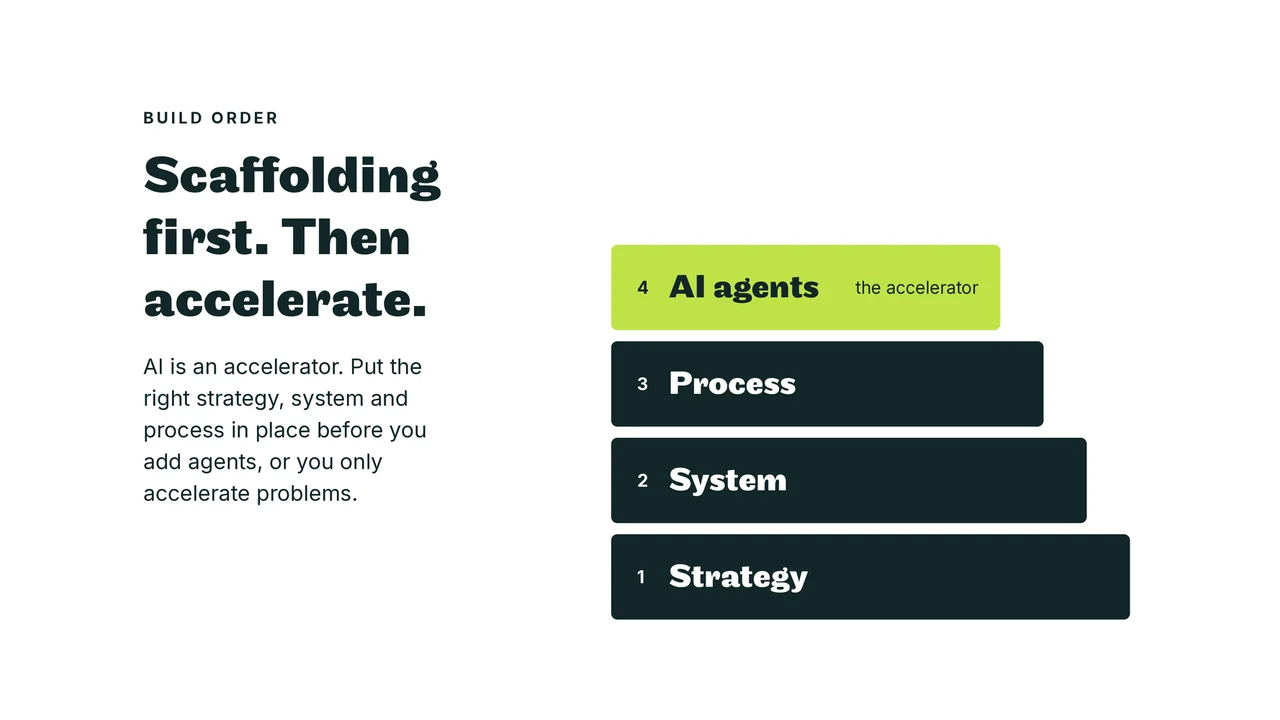
The biggest drawback is that this is an accelerator. If you don’t have a good strategy, a good system, or a good process, and you put AI behind it, all you’re doing is accelerating problems. So it’s critically important that you have the right systems, the right strategies and the right processes in place before you accelerate it with AI.
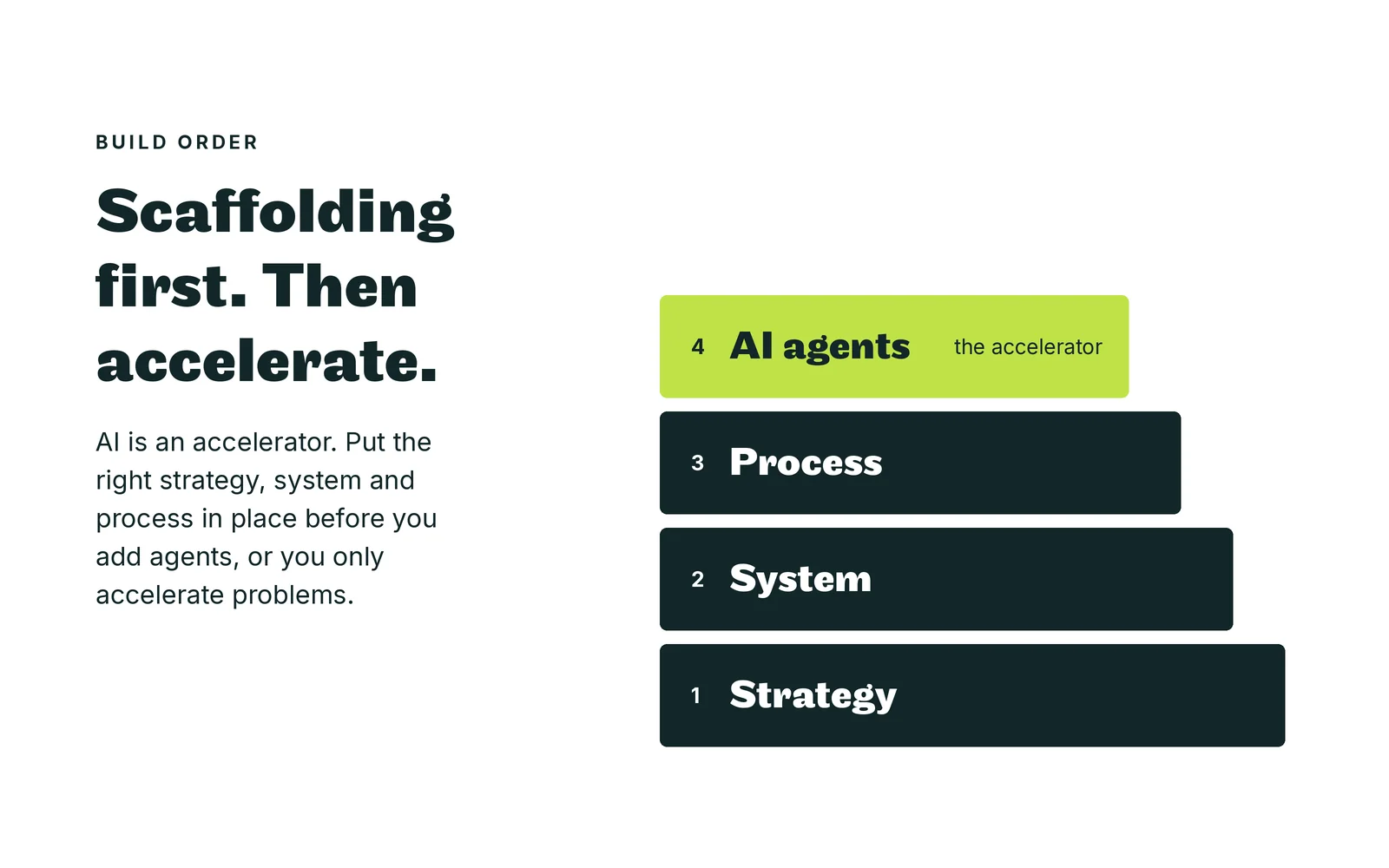
My biggest mistake when I started using agentic AI is I brought in way too many bots way too fast. You’re better off doing it slow, methodically, and getting it done well. As the agents perform more consistently, you build trust with them. That trust opens up your time to start building out other agents and other projects. Like in a construction project, you would start building the scaffolding before you go right in to build the building.
This takes leadership time. I spend almost all my day reviewing and offering feedback. Agents make mistakes, and a person has to catch them. That review is the job.
AI will make average work less expensive. Leadership is what makes work exceptional.
Where to start this week
- Pick one job that repeats every week. Choose something your team does the same way each time.
- Write its card. Manager, KPI with a live source, title and a job description with as much detail as the job needs. Then write what good looks like in plain words.
- Set a weekly review. Put it on the owner’s calendar. Weigh the output against what good looks like and give feedback at the right level.
Don’t add a second agent until the first does the job well. Go slow, go methodically and get it done well.
If you want a second set of eyes on where your growth stalls, book a Business Growth Stack Session. In 60 minutes, a senior business coach maps your pipeline on your real numbers and shows you what to fix first. No fee.
FAQ
Should AI agents be on the org chart?
Yes. Give each agent a seat with a clear role and a named manager. The seat shows what work the agent owns and who reviews it. The manager, not the agent, stays accountable for the result, the same way a manager answers for a remote hire’s work.
What KPI should an AI agent have?
An AI agent should have one number tied to a company goal, with a named live data source such as your CRM. If you cannot name the source, the agent does not have a KPI yet. Activity is not a result, so measure the outcome the work should move.
What is the downside of treating AI agents like employees?
People can stop owning the result and start blaming the agent. It also takes real leadership time to review work and give feedback. The fix is one named owner per agent who answers for the result and reviews the work every week.
Related: Setup → Sales → Scale
- Setup: What should I do first if revenue is unpredictable and I’m still closing every deal?
- Setup: What Changes in the First 90 Days With a Business Coach
- Sales: Why Hiring a Salesperson Did Not Fix Your Pipeline
- Scale: How to Use AI to Scale a Service Business
- Scale: How to Stop Being the Bottleneck in Your Business
- Scale: Why You Can’t Hire Your Way Out (And What Actually Works)
- Listen: How AI Agents Are Giving Founders an Unfair Advantage
The Predictable Profits Newsletter
Build a More Predictable Pipeline. Close More of the Right Deals.
Get practical lessons each week to help you generate more qualified leads, improve sales conversion, and create consistent growth without relying on heroics or luck.


