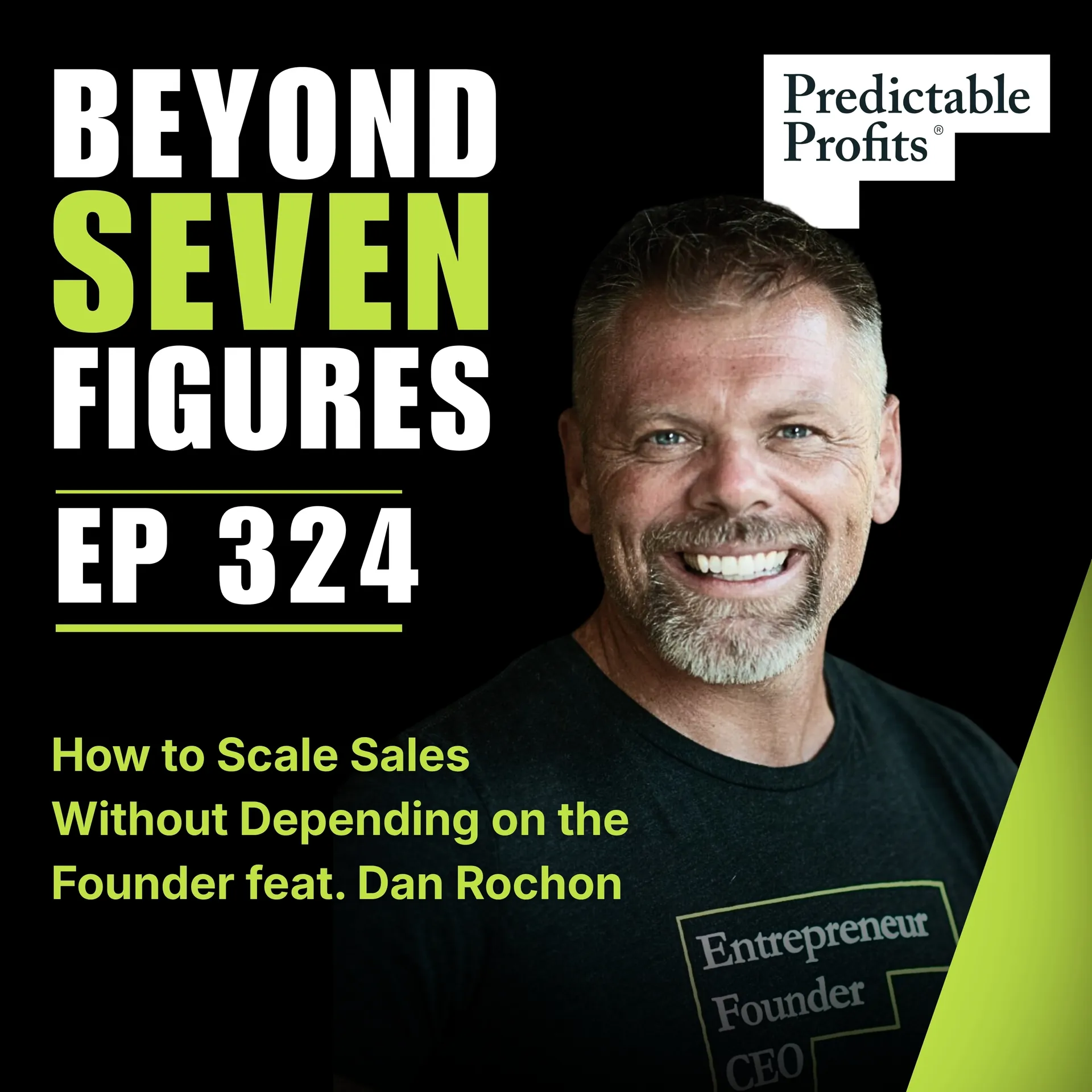
Episode 324: How to Scale Sales Without Depending on the Founder feat. Dan Rochon
Most founders do not have a lead problem. They have a sales-dependency problem: every important close still needs them in the room. Dan Rochon and I talk about teaching a trust-based sales process the team can run. If you still close every deal, start with unpredictable revenue.
Dan is the author of Teach to Sell. We also talked about his time in the military, and about more than 12 years at Keller Williams. I wanted him on the show for a simple reason. Too many sales trainers still treat pressure as a badge of honor. I had just gotten off a call with someone who likes to bully his way into a proposal. That is not a system you can hand to a team.
Dan’s shift is easier to say than to build. The old way is “let me convince this person to buy.” The better way, in his words, is “let me teach this person how to make the right decision.” That is what he means by Teach to Sell. When trust only lives with the founder, the business gets stuck. When the conversation is something the team can understand, practice, and repeat, trust can scale.
The first reason founders stay in every deal is complexity. Dan’s point: early on, a six-figure founder will take money from almost anyone. Every deal gets a custom price and a custom proposal. If you never simplify that, you cannot get out of founder-led sales. The second reason is hiring without a playbook. A lot of founders skip writing down how they actually sell, then hire someone with a résumé, say “go get them,” and do no coaching. Thirty to 60 days later, they decide they are bad at hiring. The hiring was not the first failure. The missing playbook was.
If you want a concrete move from this episode, change the interview. Dan has the candidate study whatever is public on the website, then role-play selling the service the moment the next call starts. He does not need the details to be perfect. He wants to see whether they listen, whether they are curious, and whether they drill down on a pain he actually expressed. His favorite test is the blow-off: “send me a proposal.” Most people say “great, what’s your email?” and end the call. The stronger move is to stay curious and ask what happens after the proposal arrives.
Rapport is part of that same system. It is not small talk about the weather. Dan describes it as a connection of energy: you can tell when you have it, and you can tell when you don’t. Stephanie, my co-founder, has a line I used on the show: how you start a conversation often decides how it ends. If you cannot establish rapport at the beginning, the rest of the sales process has less to work with.
This is the same problem we cover in how to break free from founder-led sales and in delegating the close. I closed the episode this way: when all the trust, clarity, and closing ability live with the founder, the business cannot scale. As marketing gets better, more deals land on your calendar, and you have less time for the work only you should do. If you ever want to sell the company, investors will also ask whether it still depends on you. If it does, you should expect a discount. Get yourself out of the seat while you can still teach the team how you sell.
KEY TAKEAWAYS:
- Most founders do not have a lead problem. They have a sales-dependency problem.
- When trust, clarity, and closing live only with the founder, the business cannot scale.
- Teach the buyer how to make the right decision. Don’t try to pressure them into one.
- Predictable revenue, in this conversation, does not come from pressure. It comes from a conversation the team can repeat.
- Custom prices and custom proposals keep the founder in every deal. Simplify before you hire.
- Write the playbook, and follow it, before you post a job.
- Hiring a résumé and skipping training is why a lot of founders decide, 30 to 60 days later, that they are “bad at hiring.”
- In the interview, have the candidate role-play selling your service. Watch how they listen, not how polished the pitch is.
- “Send me a proposal” is often a blow-off. Stay in the conversation and ask what happens next.
- Rapport is a connection of energy, not a question about the weather.
- If you want to sell the company later, founder-dependence is one of the discounts buyers will look for.
Connect with Dan Rochon:
- Book: Teach to Sell
- Website: Teach to Sell. Dan said buyers who come through that site also get access to on-demand training he priced at $10,000.
Learn more about Predictable Profits and the Predictable Profits Community.
Growing a business is hard, but it doesn’t have to be. In this podcast, we discuss strategies for growing and expanding a business beyond seven figures.
The show mixes practical teaching with expert interviews so you can take ideas back to your company and use them. Enjoy the show.
Please rate, review, and subscribe so you don’t miss future episodes. Your reviews help us improve the show.
Follow Charles Gaudet and Predictable Profits on social media: Facebook: facebook.com/PredictableProfits Instagram: instagram.com/predictableprofits Twitter: twitter.com/charlesgaudet LinkedIn: linkedin.com/in/charlesgaudet Visit: Predictable Profits Predictable Profits Community
FAQ
Why can’t a founder scale sales by staying in every deal?
Because growth hits a ceiling when every important conversation depends on one person. Charles closed this episode by saying that when trust, clarity, and closing ability all live with the founder, the business cannot scale. Buyers and investors also discount a company that still depends on the founder.
What should replace high-pressure selling?
A repeatable, trust-based process that feels more like teaching than convincing. Dan calls that method Teach to Sell: better questions, real rapport, and help the buyer make the right decision, instead of forcing a close. Predictable revenue, in this conversation, does not come from pressure.
What should you do before hiring salespeople?
Document and simplify how the founder actually sells, so a new person can learn it. Dan’s warning is that most founders skip the playbook, hire someone with a résumé, and then blame hiring 30 to 60 days later. In interviews, he has candidates study the public website, then role-play selling the service the moment the next call starts.
Did you catch our last episode?
So don’t forget to subscribe to the show to get that episode as soon as it is released. Until then, be profitable.

The Predictable Profits Newsletter
Build a More Predictable Pipeline. Close More of the Right Deals.
Get practical lessons each week to help you generate more qualified leads, improve sales conversion, and create consistent growth without relying on heroics or luck.