
Your business isn’t scaling because you’re stuck in the grind.
If you’re a B2B founder relying on one-off sales or constantly chasing new clients, you’re leaving money on the table. The real winners? They’re doubling down on Monthly Recurring Revenue (MRR) – the ultimate measure of stability, growth, and freedom.
Here’s the playbook:
- Retention over acquisition: Upsell, cross-sell, and expand existing accounts.
- Cut churn: Strong onboarding and customer success create loyal, high-value clients.
- Systematize everything: Build processes that free you from the day-to-day grind.
The best companies aren’t just growing – they’re growing predictably. They’ve shifted from founder-led chaos to systems-driven growth.
Ask yourself:
- Are you squeezing the most value from your current clients?
- What would break if you stepped away from sales for a month?
- How much growth are you leaving on the table by relying on hustle over systems?
Mic drop: If you’re the bottleneck, your business isn’t scaling – it’s stalling. Build systems that scale without you.
Current MRR Growth Trends in B2B Companies
B2B companies are moving away from quick fixes and focusing on strategies that deliver consistent, recurring revenue over the long haul.
MRR Growth Rate Benchmarks
The pace of monthly revenue growth has slowed compared to earlier years, but the top-performing companies are thriving by playing a smarter game. They strike a balance: bringing in new customers while strengthening relationships with existing ones. This dual focus keeps revenue retention high and growth steady. The data highlights clear differences in how companies of various sizes approach this challenge.
Growth Differences by Company Size
Smaller and larger B2B companies are taking different paths to growth. Smaller firms often see bigger percentage gains by winning new customers. On the other hand, larger companies lean on expanding existing accounts, turning small wins into significant revenue streams over time. This shift reflects a move from one-off tactics to a more systematic approach to scaling.
Larger firms often adopt a “land and expand” strategy. They start with smaller contracts and grow them steadily. This method not only builds dependable revenue but also sets the foundation for long-term stability.
2-Year Growth Comparison
Over the last two years, many companies have pivoted from chasing rapid, acquisition-heavy growth to prioritizing operational stability and lasting value. The focus has shifted to areas like customer success, product improvements, and refining sales processes. While this has lengthened the payback period for acquiring new customers, it’s also accelerated revenue growth through account expansions.
Looking at the data from this period, the benefits of these strategic changes are clear. Companies with strong onboarding and customer success programs are seeing better retention rates and reduced churn. The takeaway? Businesses that embrace structured, process-driven growth are building more predictable revenue streams, reducing their reliance on founders to keep the engine running.
What Drives and Limits MRR Growth
Let’s dig into what fuels monthly recurring revenue (MRR) growth – and what holds it back. For B2B companies, knowing where to focus resources can mean the difference between scaling fast or stalling out. The trends are clear: companies that grow quickly do things differently than those stuck in neutral.
Expansion Revenue and Customer Retention
Growth isn’t just about landing new clients anymore. The real game-changer? Expansion revenue. Companies that maximize the potential of their current customer base consistently outperform those who chase only new leads.
Top-performing B2B companies are generating significant revenue by upselling, cross-selling, and upgrading plans for existing customers. This isn’t just about squeezing more money out of accounts – it’s about building loyalty and delivering long-term value. It’s a shift from the endless grind of chasing new prospects to deepening relationships with those already on board.
Net revenue retention (NRR) is the gold standard here. A strong NRR shows that a company isn’t just keeping customers – they’re increasing the value of those relationships over time.
How do they do it? Customer success programs. By assigning dedicated success managers to key accounts, companies can align with customer goals and naturally uncover upsell opportunities. The trick is timing: initiate expansion discussions after customers see results. That’s when they’re most open to hearing about additional services that can enhance their experience.
Rising Customer Acquisition Costs
Acquiring new customers is getting more expensive. Marketing channels are crowded, competition is fierce, and costs are climbing. This has forced companies to rethink their approach, focusing instead on maximizing customer lifetime value (LTV).
Smart companies are extending LTV by investing in onboarding, training, and ongoing support. When customers feel supported and see value quickly, they stick around longer, fundamentally changing the economics of acquisition.
Take referral programs, for example. A well-designed referral system lowers acquisition costs and brings in customers who typically stay longer and spend more. It’s a win-win: lower costs and higher-quality leads.
Some companies are even shifting budgets away from acquisition and putting more into retention and expansion. Why? Because investing in customer success often delivers higher returns by unlocking more revenue from existing accounts.
Efficiency Metrics That Matter
Operational efficiency is the backbone of MRR growth. Metrics like revenue per employee offer a clear snapshot of how effectively a company is scaling. If this number is low, it’s often a sign of deeper profitability and growth issues.
Sales efficiency is another critical piece. Companies that get more out of their sales and marketing spend tend to see better financial results. On the flip side, inefficiency here can drain cash flow, leaving less room to invest in growth.
Time-to-value is equally important. How fast can you show customers the benefits of your solution? The quicker they see results, the more likely they are to stick around and expand their accounts.
One major roadblock to growth is founder dependency in sales. If the founder is the linchpin for closing deals, the company risks bottlenecks that hinder scaling. The solution? Systematize sales, customer success, and operations to reduce reliance on any single individual.
Lastly, cohort analysis is a must. By regularly reviewing performance data, companies can spot trends and inefficiencies early. This proactive approach helps fine-tune strategies, ensuring sustained MRR growth. These insights pave the way for smarter, more scalable growth strategies.
Questions to Consider
- Are you prioritizing expansion revenue over constantly acquiring new customers?
- How effectively are you balancing acquisition costs with lifetime value?
- What systems can you implement to reduce reliance on key individuals in your sales process?
Mic Drop Insight: Your growth potential isn’t just about getting more – it’s about making the most of what you already have. Scale smarter, not harder.
New Methods for Consistent MRR Growth
The old playbook for MRR growth is falling short. Cold outreach and generic email blasts don’t cut it anymore. B2B companies are shifting to smarter, more systematic approaches that deliver steady, predictable results. These new strategies focus on precision, automation, and creating seamless customer experiences that naturally drive revenue. By prioritizing efficiency and retention, these methods are reshaping how businesses grow monthly recurring revenue.
Revenue Marketing and AI Tools
Marketing isn’t just about generating leads anymore – it’s about driving revenue. Companies are leveraging AI-powered tools to zero in on the leads most likely to convert and grow over time, shifting the focus from volume to value.
Predictive analytics is transforming customer acquisition. AI tools analyze behavior patterns, usage data, and engagement metrics to pinpoint which prospects have the highest potential. This ensures sales teams spend their time on leads that matter, instead of chasing every inquiry.
Personalization has also taken a giant leap forward. AI platforms now customize messaging, content, and product recommendations for thousands of prospects at once. This level of tailored engagement, unthinkable just a few years ago, is becoming the new standard for companies serious about scaling their MRR.
Account-based marketing (ABM) has gone deeper. Instead of broad campaigns, businesses are crafting highly targeted experiences for specific accounts. By using intent data, they can detect when a prospect is actively researching solutions and deliver perfectly timed content to guide them through the buying process.
The secret sauce here is tying marketing efforts directly to revenue. Companies are tracking metrics like how many MQLs convert into paying customers, the average deal size by channel, and customer lifetime value by acquisition source. This data-driven strategy not only fuels growth but also reduces founder dependency, creating a more scalable system.
Better Customer Success Programs
Customer success is no longer just about retention – it’s a revenue driver. The top-performing B2B companies treat their customer success teams as engines for growth.
Take activation rates, for example. Companies are laser-focused on helping new customers see value quickly. They’re designing guided onboarding experiences, automating check-ins, and assigning success managers to high-value accounts from the start.
Pricing strategies are getting smarter too. Instead of offering one-size-fits-all plans, businesses are introducing tiered packages that encourage natural upgrades. Usage-based pricing models are also gaining traction, aligning a company’s revenue with the success of its customers.
Health scoring systems are another game-changer. By tracking product usage, engagement, and outcomes, success teams can identify opportunities for expansion before customers even realize they need them. This proactive approach ensures customers are consistently getting value – and spending more.
The best programs combine technology with a personal touch. While automation handles routine tasks and data analysis, human success managers focus on strategic conversations about growth and goals. This blend of tech and human insight not only boosts retention but also drives predictable revenue growth.
Self-Service Options and Automation
Self-service is no longer optional – it’s essential for scaling MRR efficiently. Today’s customers want to explore, trial, and even buy solutions without going through a salesperson.
Product-led growth is driving this shift. Businesses are creating products that sell themselves through free trials, freemium models, and intuitive user experiences. When prospects can experience value firsthand, conversion rates skyrocket.
Automation plays a big role in streamlining the customer journey. Companies are building seamless digital experiences that guide new customers through setup and onboarding without manual intervention. This reduces friction and speeds up time-to-value.
In-app messaging and guided tours help users discover features they might otherwise overlook. These tools deliver contextual suggestions based on behavior, encouraging natural upsells without pushy tactics.
Knowledge bases and community forums are becoming key revenue enablers. When customers can find answers and learn advanced techniques on their own, they’re more likely to fully adopt the product and see opportunities for upgrades.
Automated billing and subscription management take it a step further. Customers can upgrade plans, add users, or purchase extra features instantly – no waiting for approvals or manual processing. This eliminates delays and ensures expansion revenue isn’t left on the table.
The smartest companies use automation to amplify their human efforts, not replace them. Routine tasks and data collection are automated, freeing up teams to focus on meaningful, high-value conversations that drive growth.
These strategies work because they align with how today’s B2B buyers want to engage. They remove friction, deliver value quickly, and create natural paths for expansion – all while building a system that drives predictable, scalable revenue.
Building Systems for MRR Growth: Lessons for Agency Owners
Growing monthly recurring revenue (MRR) for B2B agencies isn’t about working harder or being everywhere at once. It’s about ditching founder dependency and building systems that allow your business to scale without you being the bottleneck. Sustainable growth doesn’t come from individual heroics – it comes from processes that work even when you’re not in the room. For agency owners, this shift is the key to escaping the trap that keeps so many stuck.
Breaking Free from the ‘Founder’s Trap’
If you’ve built a $1 million, $3 million, or even $10 million agency, but you’re clocking 60+ hours a week and can’t step away without things falling apart, you’re in what’s called the “Founder’s Trap.” This is when your business relies so heavily on you that it can’t function without your constant involvement.
Here’s how it plays out: you’re the one closing deals, managing client relationships, and solving every problem that comes up. The business depends on your energy, availability, and ability to juggle it all. And when you’re stretched thin, revenue becomes unpredictable. Sales slow down because you’re too buried in operations to focus on growth. Your team waits for your direction instead of taking ownership, turning them into order-takers instead of problem-solvers.
The real problem isn’t your work ethic or skills – it’s the way the business is set up. It’s running on you instead of systems. Every decision, every crisis, every client interaction has your fingerprints on it. This dependency is what keeps you stuck.
The way out? Systems. You need processes that operate without your constant input. Think about it: instead of asking, “How can I do this better?” start asking, “How can this be done without me?” The goal is to stop being the hero and start being the architect who builds systems that prevent fires before they start.
Predictable Profits‘ MRR Growth Method
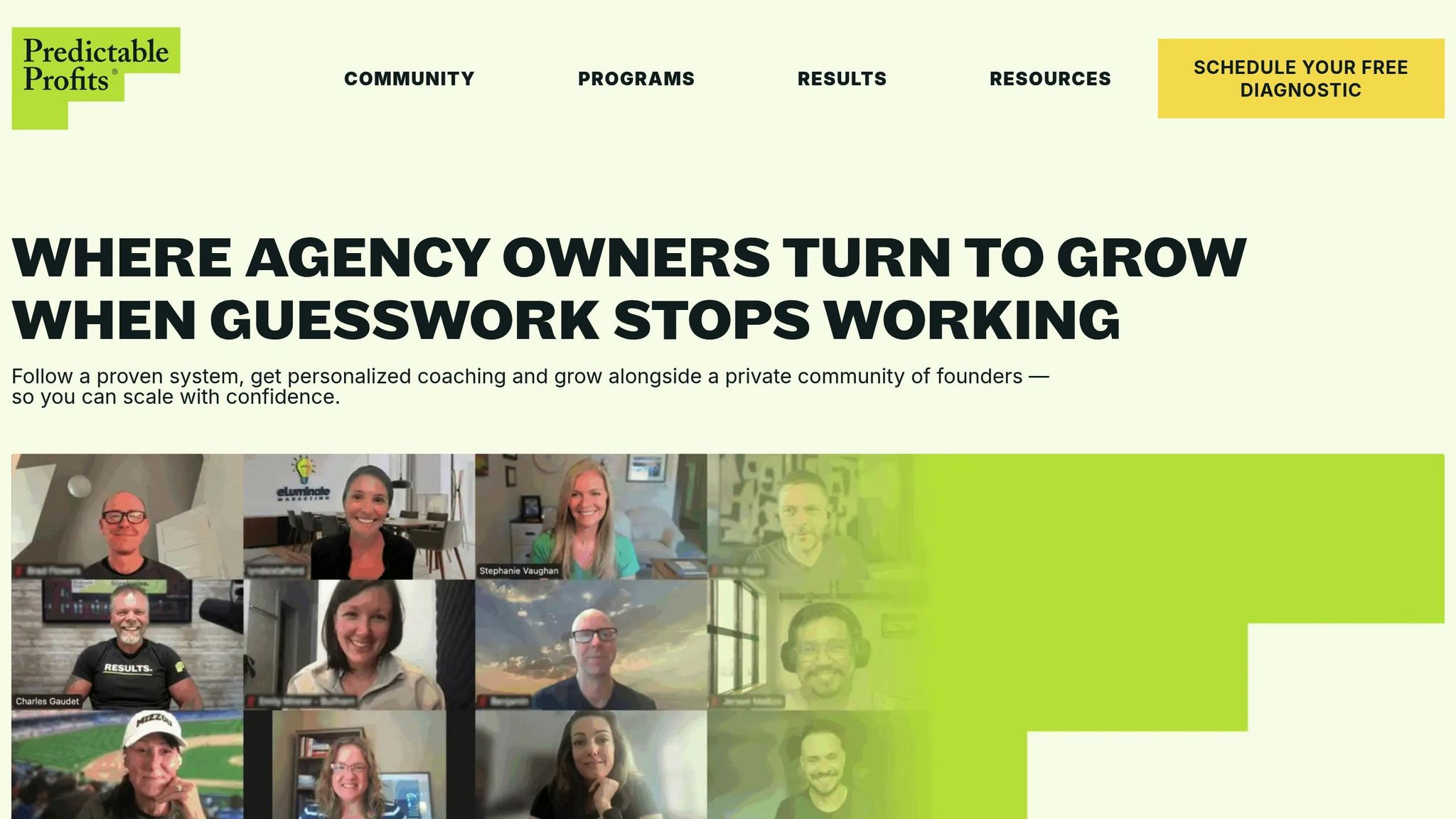
At Predictable Profits, we’ve developed a framework specifically for agency owners who want to escape the Founder’s Trap and scale predictably. This isn’t generic business advice – it’s a proven system tailored to the unique challenges of agencies looking to grow without adding more pressure on the founder.
The framework focuses on three core components: Setup, Sales, and Scale.
- Setup: This is all about creating predictable lead generation systems that don’t depend on your personal network or constant hustle.
- Sales: Here, we build processes for consistent revenue that don’t rely on your ability to close every deal yourself.
- Scale: Finally, we develop operational frameworks that ensure quality delivery without you micromanaging every detail.
These systems solve the biggest fear most agency owners have: that stepping back will lead to a drop in quality. Instead, they create a business that runs smoothly, grows predictably, and delivers consistent results – whether you’re there or not.
Our approach prioritizes systems over hustle and predictability over chaos. It’s about turning your agency into a valuable asset that can grow without being tied to you. This shift mirrors how top B2B enterprises achieve sustainable MRR growth – by relying on repeatable processes, not individual effort.
We deliver this through structured programs designed for agencies at different revenue levels. For example:
- The Launchpad program supports agencies earning $250,000 to $1 million annually.
- Higher tiers – Gold, Platinum, and Diamond – are tailored for agencies scaling to $10 million and beyond.
Each program provides the tools, coaching, and community needed to implement these systems effectively. On average, clients see a 43% revenue increase and reclaim over 15 hours per week. But the bigger win? They build businesses that grow predictably without needing their constant presence.
This transformation doesn’t happen overnight, but it follows a clear path. You go from being the primary salesperson to leading strategically. You shift from managing every client relationship to overseeing systems that ensure client success. And you step out of the operational bottleneck to become the visionary driving growth.
The bottom line? MRR growth isn’t just about landing more clients. It’s about creating systems that acquire, serve, and retain clients without you being the linchpin. When you remove yourself as the single point of failure, you unlock the ability to scale sustainably – and finally build a business that works for you, not the other way around.
What’s one area of your business that would collapse without you right now?
How much time could you reclaim if your team operated without waiting for your direction?
What would your business look like if it grew without relying on your constant involvement?
The bold truth: If your business can’t run without you, it’s not a business – it’s a job. Systems change that.
Key Points for B2B Companies and Agency Owners
If you’re running a B2B company or agency, there’s a clear roadmap emerging for sustainable growth in Monthly Recurring Revenue (MRR). The trends are unmistakable: while many companies are seeing steady growth year over year, the top players are pulling ahead by focusing on retention and upselling. Why? Because growth fueled by existing customers is not only more predictable but also more profitable.
Chasing new customers without prioritizing retention or upselling is a losing game. The most successful B2B companies are doubling down on their current client base, driving growth through upsells, cross-sells, and contract expansions. It’s not just about landing the deal – it’s about maximizing the lifetime value of every customer.
Metrics have shifted, too. The smartest companies track Net Revenue Retention (NRR) and aim for faster payback on Customer Acquisition Costs (CAC). These metrics reveal the health of your business. Struggling with them? It’s often a sign your company leans too heavily on founders for revenue-driving activities – a bottleneck that limits scalability.
Automation and self-service are now the backbone of modern MRR growth. AI-powered revenue marketing is phasing out old-school lead generation tactics, while customer success programs are becoming more proactive and data-driven. Without these tools, growth slows, and competitors will leave you behind.
For agency owners, the message is even more urgent: scaling requires systems, not heroics. The most successful agencies have moved beyond founder-led sales and operations. Instead, they’ve built repeatable, independent processes that don’t rely on one person’s hustle. This shift from “all hands on deck” to systematized operations separates agencies that grow from those that stall.
With acquisition costs climbing, the answer is clear: focus on retention, automate where possible, and build systems that scale. Agencies still leaning on their founders for lead generation, sales, or daily operations are at a disadvantage. The solution? Create frameworks for predictable lead flow, consistent sales execution, and operational excellence – all without constant oversight.
Here’s the bottom line: the companies and agencies thriving today are the ones embracing automation, prioritizing existing customers, and building systems that run without them. These aren’t just trends – they’re the new rules of the game.
Ask yourself:
- Are you investing enough in retaining and expanding your current customer base?
- How reliant is your business on you or your leadership team for day-to-day operations?
- What systems can you implement today to make growth more predictable?
The game-changer? Growth isn’t about working harder – it’s about building smarter systems that let your business thrive without you in the driver’s seat. That’s how you scale. Mic drop. 🎤
FAQs
What strategies can B2B companies use to balance customer acquisition and retention for sustainable MRR growth?
To drive steady MRR growth, B2B companies must craft a customer journey that balances both acquisition and retention. This starts with tapping into data-driven insights to pinpoint your most valuable customers. Once identified, automation can play a key role in building relationships and keeping churn at bay.
Equally important is aligning your marketing strategy to attract customers who are more likely to stick around for the long haul. Adding loyalty initiatives – like rewards programs or tailored experiences – can deepen these relationships and create a foundation for consistent revenue growth.
How can agency owners reduce founder dependency and scale their business predictably?
To break free from founder dependency and achieve predictable growth, agency owners need to focus on systems. Start by implementing standardized workflows, automation tools, and well-documented processes. These steps create consistency, ensuring the business runs smoothly without the founder constantly stepping in.
Next, build a leadership team you can trust. Delegate key responsibilities and empower your team to make decisions. This shift not only streamlines operations but also allows you to focus on driving strategic growth.
Finally, don’t put all your eggs in one basket. Diversify your client base and establish predictable revenue streams. These moves reduce risk and set the foundation for sustainable, scalable growth.
How can AI and automation improve customer success programs and help grow MRR in B2B businesses?
AI and automation are reshaping customer success programs by leveraging predictive analytics to stay ahead of customer needs, cut churn, and identify upsell opportunities. With these tools, businesses can improve client retention while driving steady and scalable growth in monthly recurring revenue (MRR).
On top of that, automation streamlines onboarding, tackles repetitive tasks, and increases operational efficiency. This frees up teams to spend more time on tailored strategies and meaningful client interactions – fueling stronger customer satisfaction and consistent revenue growth.
Related Blog Posts
- How Recurring Billing Automation Boosts Revenue
- B2B Growth Roadmap: Key Steps
- Recurring Revenue in B2B Models
- Client Retention Data: Systems That Increase LTV for Agencies
The Predictable Profits Newsletter
Build a More Predictable Pipeline. Close More of the Right Deals.
Get practical lessons each week to help you generate more qualified leads, improve sales conversion, and create consistent growth without relying on heroics or luck.


