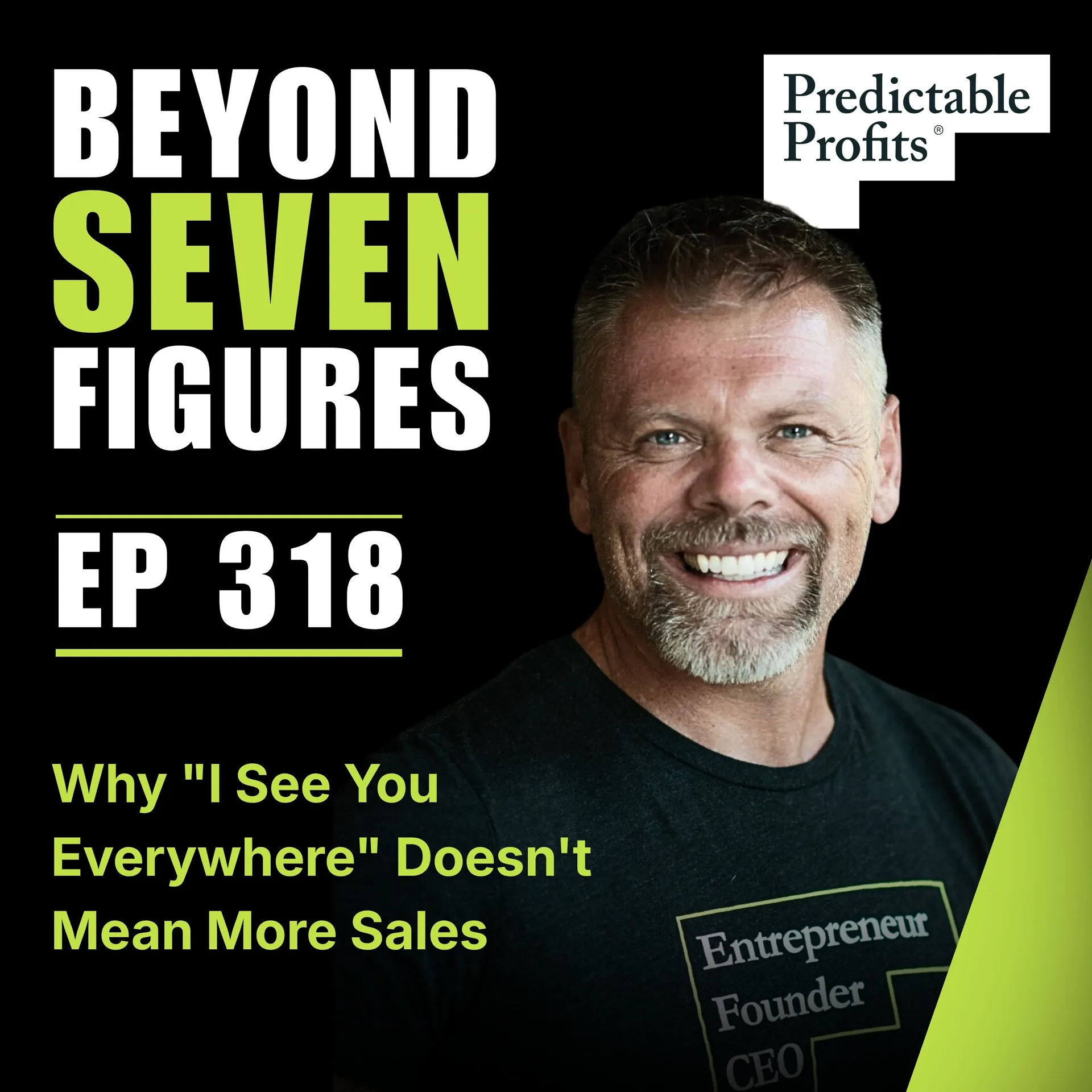
Episode 318: Why “I See You Everywhere” Doesn’t Mean More Sales
“I see you everywhere” is not the same thing as more sales. Tom Trush, Joe Beecroft, and I talk about why visibility is not revenue, and how consumption content and conversion content have to work together. If the company still runs through you, start with the Founder’s Trap. If the issue is a quiet pipeline, read why consumption drives revenue.
Tom and Joe are on the Predictable Profits team. The problem we keep seeing is a founder who posts constantly and still has a flat pipeline. They are collecting attention. They are not creating a next step. Attention without action is just noise with a nicer logo.
We split the work into two jobs. Consumption content is how someone gets to know you and starts to trust that you understand the problem. Conversion content is how you find out whether they are ready to do something about it. That next step can be a video, a reply, or a conversation, not only a purchase. A lot of founders only publish the first kind, then wonder why the sales cycle never moves.
Silence is not always a failure. On the episode we talked about buyers who consume across channels and stay invisible. They may never like or comment, and still show up later already decided. Comments are a useful signal. They are not the only one. The work is to give people enough of the right content to consume, then give them a clear way to convert.
If you want a concrete move from this conversation, take your next piece of content and decide, in advance, whether it is meant to be consumed or meant to convert. If everything you publish is only meant to be seen, you will keep hearing “I see you everywhere” and still have a quiet calendar.
KEY TAKEAWAYS:
- Visibility is not revenue. Being seen is not the same as being known for a problem you solve.
- Consumption content builds trust and demand.
- Conversion content asks for a measurable next step, which can be smaller than a sale.
- A library of only consumption content leaves you with attention and no pipeline.
- Buyers often consume silently. A lack of comments does not automatically mean the content failed.
- Decide, before you publish, whether the piece is meant to be consumed or meant to convert.
- This is a strategy problem, not a posting-volume problem.
Learn more about Predictable Profits and the Predictable Profits Community.
Growing a business is hard, but it doesn’t have to be. In this podcast, we discuss strategies for growing and expanding a business beyond seven figures.
The show mixes practical teaching with expert interviews so you can take ideas back to your company and use them. Enjoy the show.
Please rate, review, and subscribe so you don’t miss future episodes. Your reviews help us improve the show.
Follow Charles Gaudet and Predictable Profits on social media: Facebook: facebook.com/PredictableProfits Instagram: instagram.com/predictableprofits Twitter: twitter.com/charlesgaudet LinkedIn: linkedin.com/in/charlesgaudet Visit: Predictable Profits Predictable Profits Community
FAQ
Why doesn’t “I see you everywhere” mean more sales?
Because being seen is not the same as being known for a specific problem you solve. Charles, Tom Trush, and Joe Beecroft’s point is that more content alone does not create pipeline.
What is the difference between consumption content and conversion content?
Consumption content builds trust and demand. Conversion content asks for a measurable next step, which can be a video, a reply, or a call, not only a purchase. On the episode they argued you need both, and that a lot of founders only publish the first kind.
If nobody is commenting, is the content failing?
Not necessarily. In this conversation they said buyers often consume silently, across different channels, and can still be moving toward a decision. Comments are one signal. They are not the only one.
Did you catch our last episode?
So don’t forget to subscribe to the show to get that episode as soon as it is released. Until then, be profitable.